
Choosing Vehicle Detection for Every Lane and Budget

Vehicle detection systems are crucial in modern traffic management, gate automation, parking lots, and security setups. As we move into more intelligent infrastructure, the demand rises for detection systems that work reliably in all weather, require minimal upkeep, and deliver useful alerts.
Over time, detection methods have evolved, from bulky inductive loops to complex video analytics.
Today’s readers need guidance. They must pick a system matching their environment, complexity, and budget.
This post helps you compare various vehicle detection systems.
You’ll learn how traditional methods stack up against newer alternatives like Cartell’s magnetic detection. And you’ll see which solution fits your lane and your budget best.
What Is a Vehicle Detection System?
A vehicle detection system senses when a car, truck, or other vehicle passes, arrives, or occupies a particular zone. Applications include: gate automation, alerting property owners, managing parking, and controlling traffic lights.
Many technologies are behind these systems: inductive loops, video analytics, magnetometers/magnetic sensors, radar, infrared, etc.
Each has strengths and trade‑offs. Choosing the right fit matters. More tech doesn’t always mean better performance, especially when simpler, well‑designed vehicle detection systems may serve your needs more reliably.
Inductive Loop Detectors: The Legacy Standard
How They Work
Inductive loop systems embed wires beneath pavement. The system senses changes in inductance when a vehicle (a large metal mass) passes over or stands above the loop.
Common Use Cases
Cities often use them at intersections to call traffic signals. Parking garages use loops at entrances/exits. They handle large volumes of traffic reliably.
Strengths
Accuracy: Exact detection for vehicles, even at low speed or stopped.
Proven reliability over many decades in many climates.
Limitations
Installation is invasive: pavement must be cut, wire laid, then sealed. Disruption and cost can be high.
Maintenance: wires can fail, joints degrade, and water intrusion causes problems. Repairs often require road closures or repaving.
Cost: Both upfront and ongoing maintenance costs tend to be greater.
Because of these downsides, many residential, commercial, and smaller-scale users seek alternatives.
Cartell’s Magnetic Vehicle Detection Systems
Cartell, known for its wireless driveway alert sensors and driveway detectors, uses magnetic field disturbance (a magnetometer‑based approach) to detect vehicles. These systems differ significantly from inductive loops.
Key Benefits
Wireless operation: No trenching or significant pavement cuts. You install sensors below ground without cutting huge loops.
Reliable in any weather: Rain, snow, hail, or heat don’t degrade detection. Magnetic sensors work even when visibility is poor.
Simple integration: These sensors work well with gates, alert systems and smart devices. Setup is more straightforward.
Low maintenance: Fewer moving parts, fewer exposed wires. Once correctly installed, the system runs for years with little attention.
Use Case Examples
Driveway detector / Driveway alert scenario: If you want a system that tells you when cars enter your driveway or approach a gate, Cartell’s wireless driveway alert sensors are ideal. They rely on magnetometer detection to sense presence without needing a camera or wired loops.
Gate automation (CP‑4 style): For more automated control, Cartell’s magnetic detection systems trigger gates to open or close automatically when a vehicle is detected.
Wireless flexibility: For long driveways, private roads, or locations where wiring is costly or impractical, wireless magnetic sensors offer the flexibility to place detector units where needed.
Video-Based Detection: Where It Fits, and Where It Might Not
How Video Detection Works
Video systems use cameras paired with software to detect motion, shape, or patterns consistent with vehicles. They may use machine learning, image analytics, or pixel change detection.
Situations Where Video Makes Sense
Municipal traffic planning or enforcement.
Large‑scale projects needing license plate recognition, traffic volume data, or behavior analytics.
Locations already covered by surveillance camera infrastructure are seeking to add detection functions.
When Simpler Detection Beats Video
Residential or small business settings: You don’t need video data; you need reliable presence detection. Cartell’s magnetic systems deliver that without privacy or lighting issues.
Budget or installation constraints: Video involves cameras, wiring (or high‑bandwidth wireless), power, and potentially licensing or processing fees. Magnetic detection is leaner.
Maintenance and environmental challenges: Cameras need cleaning, power, light sources, and weather protection. Magnetic sensors below ground avoid many of those issues.
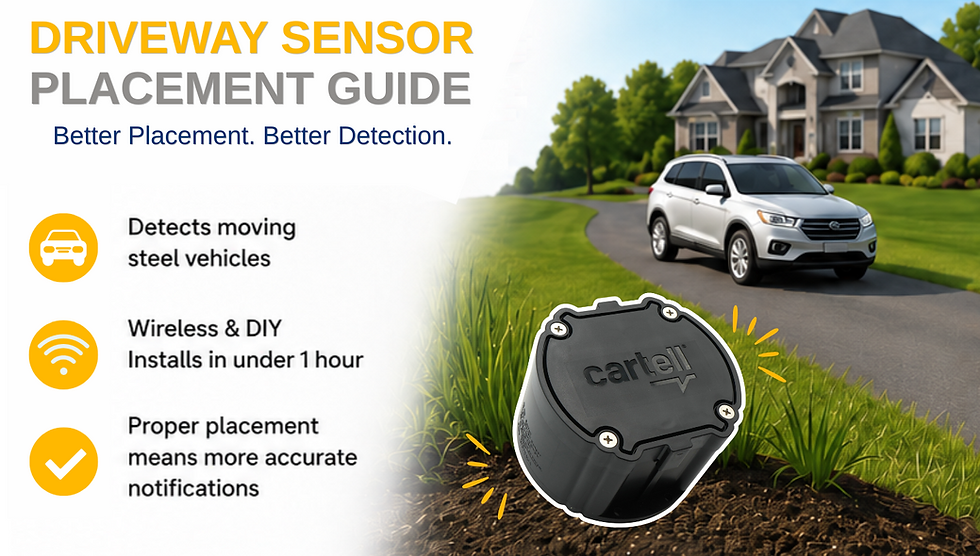
Feel free to read this post on the best place to install your sensor. Or, if you are looking for the latest choice of which type of systems to buy in 2026, visit our latest blog here.


Comments