
Best Driveway Systems for Long Driveways (2026 Guide)

Updated: Jun 23

If you have a long driveway, you already know the problem: by the time someone reaches your house, gate, garage, or front door, you may have had little to no warning.
For rural homes, farms, gated properties, long private roads, and large residential lots, the driveway is not just a place where vehicles enter. It is the first point of awareness.
A basic camera may show you who arrived after they are already close. A motion sensor may notify you, but it can also be triggered by animals, wind, trees, weather, shadows, or other movement. For short driveways, that might be acceptable. But for long driveways, reliability becomes much more important.
The best driveway system is not always the cheapest system or the most complicated system. The best system is the one that fits your property, detects what matters, and gives you enough warning before a vehicle reaches your home.
In this guide, we will break down the main types of driveway systems, what each one does well, where each one has limitations, and what to consider if you want dependable vehicle detection for a long driveway.
Why Long Driveways Need A Different Kind Of Awareness
Long driveways create a unique security and awareness challenge.
With a short suburban driveway, you may hear a car pull in. You may see headlights through the window. A doorbell camera may catch someone as they approach the house.
But with a long driveway, the arrival point is often far away from the home.
That distance creates several problems:
You may not hear the vehicle arrive.
Cameras may not notify you early enough.
Wi-Fi coverage may be weak near the entrance.
Trees, animals, weather, or shadows may trigger false alerts.
You may want to know when someone enters the property, not just when they reach the house.
For many homeowners, the goal is simple:
Know when a vehicle enters the driveway before it reaches the home.
The Main Types of Driveway Systems

Most driveway alert systems fall into one of four categories:
Motion sensor systems
Camera-based systems
Break beam or hose-based systems
Magnetometer technology detection systems
The right choice depends on your driveway length, environment, budget, and how much reliability you need.
1. Motion Sensor Driveway Systems
Motion sensor driveway alarms are common because they are usually affordable and easy to install. For simple awareness, they can be a helpful entry-level option.
Best For
Motion sensor systems are often a good fit for:
Short driveways
Budget-conscious homeowners
Simple alerts near the house
Areas with limited wildlife or movement
Pros
Motion sensors are usually:
Easy to install
Affordable
Widely available
Good for general motion awareness
Limitations
The main limitation is that motion sensors detect movement, not just vehicles.
That means they may be triggered by:
Animals
People walking by
Wind-blown branches
Heavy rain or snow
Shadows or changing light
Passing movement near the sensor area
For some homeowners, that is fine. But for longer driveways, false alerts can become frustrating. If a system alerts you too often when no vehicle is actually there, you may eventually stop trusting the alert. And once you stop trusting the alert, the system becomes less useful.
2. Camera-Based Driveway Systems
Cameras are a major part of modern home security. They are useful because they show you what is happening visually.
A camera can help you see:
Who arrived
What vehicle entered
Whether someone approached the house
What happened after the alert
For many homeowners, cameras are an excellent layer of security.
Best For
Camera systems are often a good fit for:
Visual confirmation
Front-door monitoring
Garage or gate areas
Recording activity
Homes with good Wi-Fi coverage
Pros
Cameras can provide:
Video footage
Remote viewing
Visual confirmation
App notifications
Integration with other smart home devices
Limitations
The limitation is that cameras are not always the best first alert system for long driveways.
A camera usually needs a clear view, proper lighting, and correct placement. If the camera is mounted near the house, it may only notify you once the vehicle is already close.
For a long driveway, that can be too late.
Cameras are very useful, but they are often strongest when paired with a dedicated driveway detection system. The driveway system tells you a vehicle has entered. The camera helps you see what is happening.
3. Break Beam and Rubber Hose Driveway Systems
Some driveway systems use a beam, hose, or physical trigger point.
A break beam system detects when something crosses between two points. A rubber hose system detects when a vehicle drives over a hose placed across the driveway.
These systems can work well in certain environments, especially where the driveway entrance is clearly defined.
Best For
Break beam or hose systems may be useful for:
Clearly defined entrances
Commercial or farm settings
Driveways where a physical crossing point is acceptable
Applications where detecting both people and vehicles may be useful
Pros
These systems can offer:
A clear trigger point
Long-range options depending on the product
Useful detection for specific driveway layouts
Limitations
The limitations depend on the specific type. A hose system may be visible on the driveway and exposed to wear. A break beam system may require careful alignment and placement. Both can be effective, but they may not be the most invisible or refined option for every residential driveway.
They are worth considering, especially for certain properties, but they may not be the ideal solution for homeowners who want a clean, low-profile vehicle detection system.
4. Magnetometer Technology Vehicle Detection Systems
Magnetometer technology detection systems are different because they are designed to detect moving steel or ferris metals, not general motion. Instead of reacting to animals, trees, shadows, or people walking by, magnetic systems detect changes caused by moving steel vehicles.
This makes them especially useful for long driveways where the homeowner mainly wants to know: “Did a vehicle enter my property?”
Best For
Magnetic vehicle detection systems are often a strong fit for:
Long driveways
Rural homes
Gated properties
Farms and estates
Homeowners who want fewer false alerts
Properties where moving steel or ferris metals detection matters
Pros
Magnetometer vehicle detection can offer:
Alerts from moving steel or ferris metals such as motorcycles, dirt bikes, bicycles, buggies, lawnmowers, and any means of vehicle with wheels and steel on it.
Fewer false triggers from animals or weather
Strong reliability for long driveways
Flexible placement options
Integration with gates, sounders, lights, cameras, or home automation depending on the system
Limitations
Magnetometer technology systems may require more intentional placement than a basic motion sensor. They are also usually a more specialized solution, which means they may not be the cheapest option.
But for homeowners who care about dependable vehicle detection, that tradeoff is often worth it.
Quick Comparison: Driveway System Types
System Type | Best For | Strength | Main Limitation |
Motion Sensor | Basic awareness | Affordable and easy to install | Can trigger from animals, people, weather, or movement |
Camera System | Visual confirmation | Shows who or what arrived | May alert too late for long driveways |
Break Beam / Hose | Defined entry points | Clear trigger location | May require visible hardware or careful alignment |
Magnetometer Vehicle Detection | Long driveways and vehicle alerts | Detects moving vehicles, not general motion | More specialized than basic motion systems |
If you have a short driveway:
A motion sensor or camera system may be enough.
If you want visual security:
A camera system is helpful, especially near the home, garage, or gate.
If you have a long driveway and want fewer false alerts:
A magnetometer vehicle detection system is usually the better fit.
If you have a gate:
A system that can integrate with gate operators, lights, sounders, or automation may be worth considering.
For long driveways, the goal is not just to detect “activity.” The goal is to detect the right activity.
Where "Cartell" Fits
Cartell specializes in vehicle detection systems designed for driveways, gates, and property awareness.
Unlike basic motion-based systems, Cartell’s magnetometer-based sensors are designed to detect moving steel vehicles. That means the system is focused on the thing most homeowners actually care about when monitoring a driveway: cars, trucks, delivery vehicles, guests, contractors, or unknown vehicles entering the property.
For homeowners who simply want to know when a vehicle arrives, the Cartell CW-CON works like a “doorbell for your driveway.”

For homeowners who want app push notifications, the CW-HUB (coming soon) adds phone connectivity.
For gate, security, and automation applications, the CW-SYS can connect vehicle detection into broader property systems.

For wired gate applications, Cartell’s CP-4 remains a trusted option for free exit and gate activation.

The key difference is this: Cartell is not trying to detect every movement on your property. It is built around dependable vehicle detection.
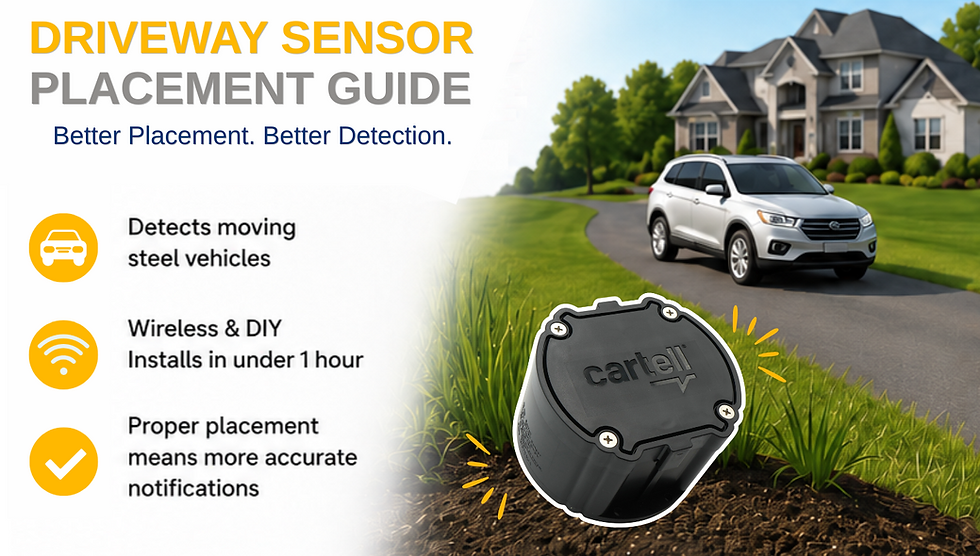
Installation Matters: Where You Place the Sensor Is Important
Even the best driveway system needs proper placement. For long driveways, placement affects how early you are notified, how reliable the system is, and whether the system detects vehicles at the right moment.
Common placement options include:
Near the entrance of the driveway
Beside the driveway
In or under the driveway surface, depending on the system
On a post adjacent to the drive
Near a gate or key entry point

For long driveways, placing the sensor closer to the entrance gives earlier warning. Placing it too close to the home may defeat the purpose because you are only alerted once the vehicle is already nearby.
“At what point do I want to know a vehicle has entered?”
For many homeowners, the answer is: as soon as the vehicle enters the property.
Common Mistakes When Choosing a Driveway System
Mistake 1: Buying Based on Price Alone
A low-cost driveway alert may seem attractive, but if it produces constant false alerts, it may not solve the real problem. Price matters, but reliability matters more.
Mistake 2: Assuming Cameras Are Enough
Cameras are useful, but they are not always the best first-alert system for a long driveway.
A camera may show you the vehicle once it is already close. A dedicated driveway detection system can notify you earlier.
Mistake 3: Ignoring False Alerts
False alerts are more than a small inconvenience.
If your system alerts too often when nothing important is happening, you may stop responding to it. That makes the system less effective over time.
Mistake 4: Placing the Sensor Too Close to the House
For a long driveway, early warning is the whole point.
If the sensor is too close to the home, you lose the advantage of having a long-range alert system.
Mistake 5: Choosing Motion Detection When You Really Need Vehicle Detection
Motion detection and vehicle detection are not the same thing.
If you only care about vehicles entering the driveway, a system designed specifically for vehicle detection is usually the better choice.
Feel free to visit our blog for a written article on the best place to install your Sensor for your property.
Final Recommendation
The best driveway system for a long driveway depends on your property and your goals.
If you only need a simple, affordable alert for a short driveway, a basic motion system may work. If you want visual confirmation, cameras are a smart addition.
If you have a defined entrance and do not mind visible hardware, break beam or hose-based systems may be worth considering.
But if your priority is dependable vehicle detection for a long driveway, magnetometer sensor detection is one of the strongest options.
For homeowners who want fewer false alerts, earlier awareness, and a system designed around vehicles - not random motion. Cartell is built for that purpose.
A long driveway should not leave you guessing when someone arrives.
With the right driveway system, you can know the moment a vehicle enters your property.
Explore Cartell Driveway Detection Systems
Cartell offers driveway notification, app-connected, wireless, wired, and gate-integrated vehicle detection systems for homes, farms, gated properties, and long driveways.
Whether you want a simple driveway sounder, mobile app notifications, gate integration, or full property automation, Cartell can help you choose the right setup for your driveway.


Comments