
Where To Place a Wireless Driveway Sensor For Best Accuracy

Updated: Jun 24
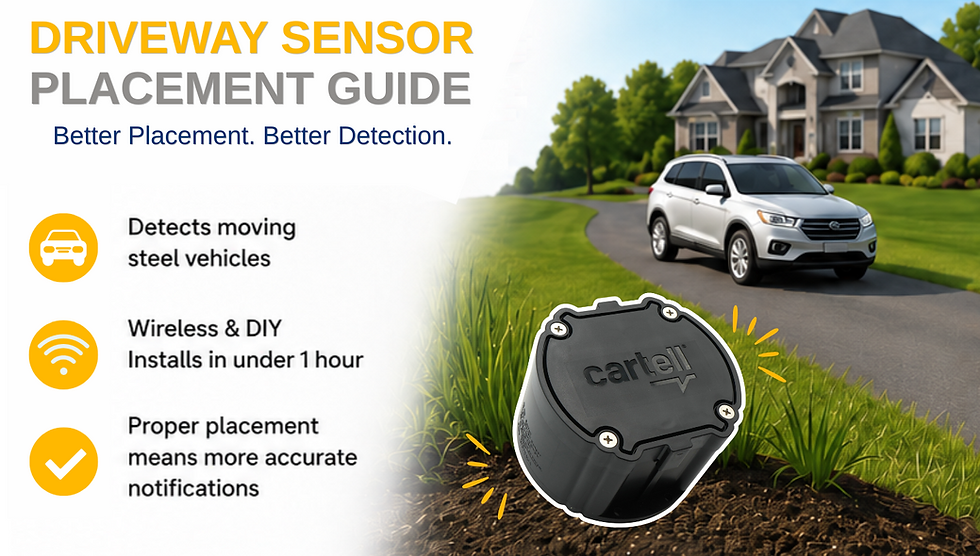
A wireless driveway sensor can be one of the simplest ways to know when a vehicle enters or approaches your driveway. For homeowners with long driveways, gated entrances, rural properties, or private roads, the right driveway notification system can provide helpful vehicle arrival awareness before it reaches the home, gate, shop, or building.
However, even a reliable detection system needs to be installed in the right location to work as intended. The sensor should be positioned where vehicles naturally pass, where it can detect vehicle activity clearly, and where it is not affected by unnecessary movement, cross traffic, or sources of electromagnetic interference.
Cartell systems use magnetometer technology designed to detect moving steel.
Because of that, proper placement is different from a basic motion sensor. It is more sophisticated, as the goal is not to detect every movement. The goal is to detect vehicles as they pass through the detection area.
This guide explains where to place a wireless driveway sensor for better vehicle detection, what locations to avoid, and how to think through sensor placement for long driveways, gated entrances, rural properties, and wider driveways.
Why Sensor Placement Matters
A properly placed sensor helps the system detect vehicle activity at the right moment. If the sensor is placed too close to a busy road, it may pick up cross traffic that is not actually entering the property. If it is placed too close to buried power wires, electric fences, or moving ferrous metal, interference may affect performance. If it is placed too far from the vehicle path, the sensor may miss vehicles that pass on the opposite side of the driveway.
Good placement helps the system focus on the vehicle activity that matters most: a vehicle entering or moving through the driveway.

Start With the Vehicle Path
Before choosing a location, look at how vehicles actually use the driveway.
Where do vehicles enter from the road?
Do they pass through a gate?
Is the driveway straight, curved, wooded, sloped, or unusually wide?
Do delivery trucks take a different path than personal vehicles?
Do larger vehicles swing wider around turns?
The best sensor location is usually near a point where vehicles consistently pass at 5mph or more.
The sensor should not simply be placed where installation is easiest. - It should be placed where it can detect the vehicle activity the property owner actually wants to know about.
For some properties, that location may be near the driveway entrance. For others, it may be near a gate, garage, barn, shop, service entrance, or another important vehicle path.
Once that question is answered, the best sensor location becomes much easier to determine.
Placement For Long Driveways
For long driveways, the sensor should generally be placed far enough away from the main road to avoid detecting vehicles that are simply passing by.
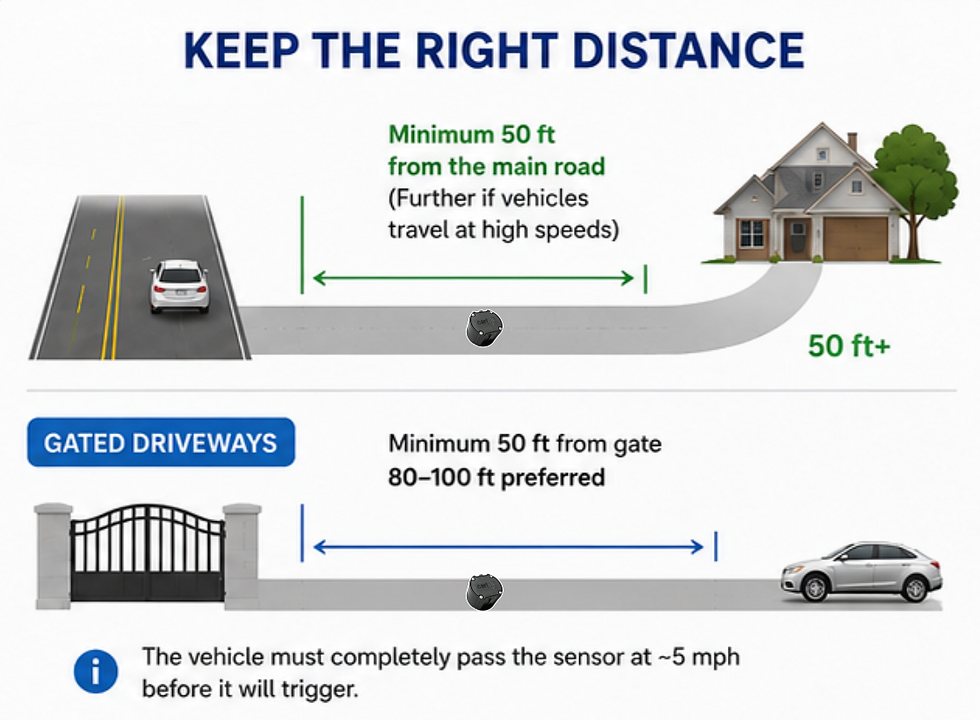
A good rule of thumb is to place the sensor at least 50 feet from the main road. If vehicles on the main road are traveling at higher speeds, placing the sensor farther back may be a better option. This helps reduce unwanted triggers from cross traffic and keeps the system focused on vehicles that are actually entering the driveway.
Long driveways also require homeowners to think about timing. If the sensor is placed too close to the house, the homeowner may not receive the notification until the vehicle is already near the home, garage, or building. If the goal is earlier awareness, the sensor should usually be placed closer to the driveway entrance, while still far enough from the main road to avoid cross traffic.
The best location balances two goals: detecting vehicles early enough, and avoiding vehicles that are not actually entering the property.
Placement For Gated Driveways
Gated driveways have their own placement requirements because the gate is often the first major access point on the property.
For gated driveways, the sensor should generally be placed at least 50 feet back from the gate. When possible, a distance of 80 to 100 feet is preferred. This gives the vehicle enough room to completely pass the sensor before the system triggers.
This matters because the vehicle needs to pass the sensor at around 5 mph for proper detection.
The purpose of the sensor placement is to detect vehicle movement through the detection area, not simply vehicles that are near the gate.
For properties with gates, placement should also take nearby equipment into account.
Avoid placing the sensor near buried power wires, gate power, or other possible sources of electromagnetic interference. If buried power is located on one side of the driveway, the sensor should generally be placed on the opposite side when possible.
Placement For Rural Homes, Farms, and Large Properties
Rural homes, farms, and large properties often have more than one important vehicle path. There may be a main driveway, private road, barn entrance, shop entrance, equipment area, service road, or gate.
In many cases, the same principles used for long driveways apply:
The sensor should be placed far enough from the main road to avoid cross traffic, close enough to the driveway to detect vehicles properly, and in a location where vehicles consistently pass.
For rural properties, the sensor may also be mounted on an immovable object, such as a large tree or a sturdy post, as long as it is close to the edge of the driveway. This can be helpful when the driveway surface or surrounding area makes other installation options less practical.
However, distance from the driveway should also not be forgotten:
Every foot away from the driveway reduces the available detection range.
For example, if the sensor is mounted several feet away from the driveway, it may not detect a vehicle driving on the opposite side of the driveway.
For farms and rural properties, it is also important to think about livestock and wildlife.
Avoid placing the sensor where cattle, deer, or other large animals could step on it, run over it, rub against it, or stomp directly on it.
Since the sensor detects movement of steel and nearby magnetic changes, movement of the sensor itself can also create unwanted triggers.
Edge Placement vs. Center Placement
For standard driveways approximately 12 to 14 feet wide, a sensor placed at the edge of the driveway can work well when the vehicle fully passes by it at around 5 mph.
For wider driveways, vehicles may pass too far from a single edge-mounted sensor. In that case, the sensor can be placed closer to the center, or a sensor can be installed on each side of the driveway.
Using sensors on both sides is often a practical option because it can help reduce missed detections without requiring the driveway to be cut for a center installation. In many cases, it may also be faster and more cost-effective.
Mounting a Sensor on a Post or Tree
When mounting the sensor this way, the sensor should be placed as close to the driveway as possible. Every foot away from the driveway reduces detection range. A sensor mounted four feet away from the driveway, for example, could miss a vehicle driving on the opposite side.
When mounted on a post or large tree, the rounded sides of the sensor should face left and right. This helps position the sensor properly for vehicles passing by.
The object used for mounting should be stable and immovable. Avoid mounting the sensor to anything that can sway, shake, move, or flex in the wind.
Wireless Range and Signal Considerations
A wireless driveway sensor needs to communicate with a receiver, sounder, hub, gate system, or other connected equipment. The farther the sensor is from the receiver, the more important it becomes to think about distance and obstacles.
Trees, hills, buildings, metal structures, terrain changes, and other obstructions can affect the signal path.
A location may be good for vehicle detection but not ideal for wireless communication.
The best placement should balance both needs.
DIY Driveway Sensor Placement Tips
Many homeowners choose wireless driveway sensors because they want a simpler installation option. In many typical residential applications, a wireless driveway notification system can be installed without complicated trenching or major changes to the property.
For example, Cartell’s wireless driveway notification systems are designed for straightforward installation, and many standard residential installations can be completed in under an hour.
Before installing the sensor, walk the driveway and watch how vehicles naturally enter the property. Identify the point where vehicles consistently pass and decide how early you want to receive the notification. Then consider nearby roads, gates, power lines, electric fences, livestock, metal objects, and wireless range.
For a simple driveway notification setup, the goal is to place the sensor where it can detect the right vehicle activity without being affected by unnecessary triggers or interference.
For more complex properties, such as gated entrances, long driveways, farms, or automation applications, it may be helpful to contact Cartell technical support, or to reach out to one of our installers for guidance before final installation.
Where Cartell Fits
Cartell specializes in driveway notification and vehicle detection systems for homes, businesses, farms, long driveways, and gated properties. Cartell systems use magnetometer technology designed to detect moving steel vehicles rather than general motion.
For homeowners who want a simple wireless driveway notification system, Cartell offers systems designed to notify you when a vehicle enters the driveway.
For property owners who want phone connectivity, Cartell offers app-connected notification options.
For gates and automation, Cartell systems can connect vehicle detection with gate operators, lights, cameras, sounders, and ot her equipment depending on the system and application.
For Cartell customers, technical support is available to help answer installation questions and provide guidance based on the property layout.
The purpose is simple: to help property owners know when a vehicle enters the driveway by focusing on vehicle activity, not general motion around the property.


Comments